
A Plague of Sheep
The McLachlans in Colonial Australia
In Kin, Kilts & Kolonie, G. Roger Knight tracks the fortunes of Scottish families whose lives became bound up with the Dutch East Indies. In Chapter 8, he follows the McLachlan family from Scotland to colonial Australia - and, for two of its sons, onward to Java and the sugar trade. This extract traces the family’s establishment in the Wimmera sheep country and examines the dispossession and frontier violence that accompanied the extraordinary expansion of Australia’s nineteenth-century wool economy.
When the young Scotsman Donald McLachlan arrived on Java at the end of May 1839, he did not do so from his native land or anywhere else in Britain. Instead, his point of departure was one of the several British settlements in Australasia – where his family, headed by a retired officer in the British army, had recently arrived. Most immediately, it was from Sydney in New South Wales that he had sailed north-west, towards the Dutch colony. Disembarking in the East Java port of Surabaya, the 27-year-old began working for the firm of Maclaine Watson, founded in the colony more than a decade earlier by a fellow Highland Scot and having among its partners one of McLachlan’s distant cousins. He was joined there in 1850 by his much younger brother James, who had spent the previous decade in the Port Phillip district of south-eastern Australia, both in the newly established city of Melbourne and on an extensive farming property in which his father and several other of his siblings had a stake.
Both men grew rich on Java, largely through their participation in the island’s rapidly expanding sugar trade, before retirements that took them back to Britain rather than to the Antipodes. Few other major global commodities – apart from cotton and cotton goods – took off so dramatically on the world stage during the nineteenth century. The factories in which cane was converted through a series of steam-driven processes into raw sugar, along with the wool sheds in which sheep were shorn by the thousand and their fleeces sorted, compressed and bailed, proliferated to feed a commerce that was worldwide, though heavily focused on consumers in Western Europe and North America. Nevertheless, there was a sharp contrast between the very different kinds of colonial appropriation characterising sheep rearing in the Antipodes and sugar manufacture in the Indies: a contrast which was determined less by the presence of settlers or sojourners than by the imperatives of the two commodities. However, they had one key dimension in common: both left the colonies in a form that required further processing in the metropole – sugar refining and weaving wool into cloth. As social actors who traded in them and had a stake in their primary production, the McLachlans were located along commodity chains that had world-wide reach.
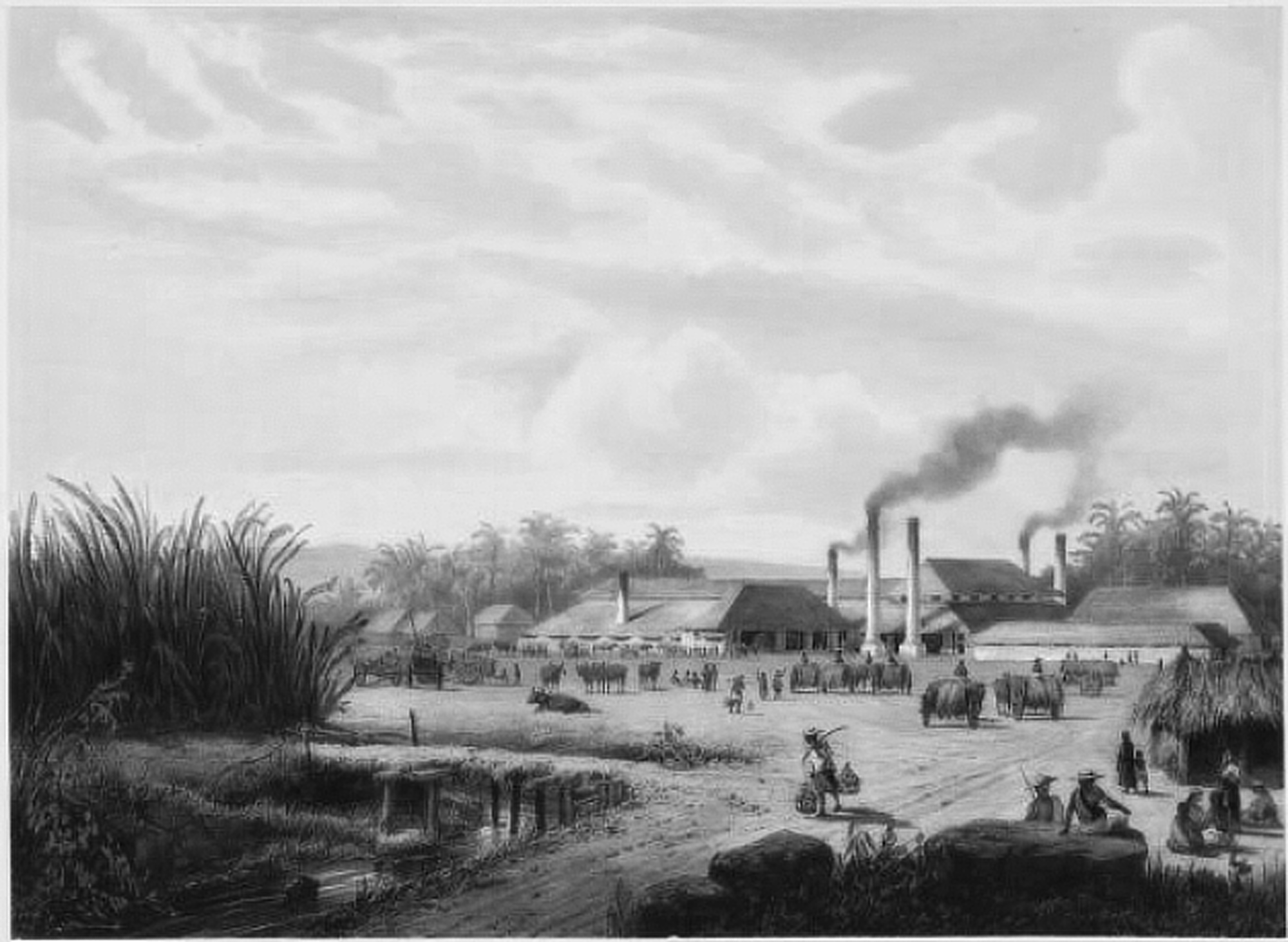
A sugar factory in Java, c.1860 (KITLV/University of Leiden)
Melbourne, the Wimmera and an Ungulate Invasion
The McLachlan family had set out from the Scottish town of Stirling, on the fringe of the Highlands some 36 miles north-west of Edinburgh, in April 1839 and disembarked in the newly established British colonial settlement of Melbourne, on Port Phillip Bay (on the south-eastern coast of Australia) some five months later. Part of the initial cost of their venture was presumably defrayed by the sale of his officer’s commission when Captain McLachlan retired from the 75th Regiment of Foot in 1838 (after more than a decade of being on half pay), raising perhaps as much as £1,800. Even so, he would likely have deployed some of this on ‘cabin class’ shipboard accommodation for himself, his wife and their nine offspring, several of whom had adult status (something calculated at between £40 and £70 or more per head). Thereafter, however, the money trail in question goes tepid if not cold.
To be sure, the financial connection between nineteenth-century Highland proprietorship and the profits derived from enslaved African labour in the British Caribbean has been highlighted in a recent study that draws particular attention to the part played by the compensation money paid to slave owners by the British Treasury in the wake of the emancipation in the 1830s. Similar, contemporary links with the Scottish diaspora in the Antipodes, it might be postulated, became a potential source of capital during at least the early phases of the rapidly expanding Australian pastoral industry, in a context in which it was otherwise in short supply. Huge fortunes need not have been involved. As has been aptly remarked, ‘Even modest investments in slavery could generate colonial expansion. . . . [S]lavery wealth [might be] just enough to pay off a debt, relocate one’s family across the world and obtain a land-grant’, and there were indeed people ‘embedded in the business of slavery who turned toward the southern hemisphere in the middle decades of the nineteenth century.’
One such was James Monkton Darlot, whose marriage in 1853, almost twenty years after his arrival in the Antipodes, brought him into a family whose ‘patriarch’, Judge Samuel Firebrace, if not himself a slave owner there, had certainly been a pillar of the slave-holding establishment in Demerara, in what was then British Guiana. But Darlot’s association with the McLachlans, to which we shall return shortly, dated from a decade prior to this (putative) access to capital from this source. Meanwhile, one of the Captain’s brothers (Ronald) was said to have been ‘a planter in the West Indies’ (but does not appear among the beneficiaries of compensation money), and the Captain’s wife, Mary Anne née Sawers, had undoubted family connections with the Caribbean holding of enslaved Africans: in particular, her uncle, ‘John Sawers of Bellfield late of the Island of Jamaica now residing in Stirling’ (he died in 1839) had been a recipient of the compensation in question. Yet the sum involved (around £1,100 for fifty-four enslaved individuals) was relatively modest (some contemporary payments to other Scottish recipients ranged from £3,676 through £8,000 to a massive £137,000), and there is no evidence that he bestowed the gains in question on his niece and her husband; his will makes no mention of them.
Evidence for the role in this case of slavery-derived wealth, in short, is far from conclusive, and it remains unclear just how Captain McLachlan was able to successfully re-establish his family on their arrival in Port Phillip in 1839. But re-establish he did. The diarist Georgiana McCrae – a woman who evidently moved in the ‘best’ circles in newly founded settlement, where the future Lieutenant-Governor and his wife were in her close acquaintance – encountered ‘Captain McLachlan and his family’ there in March 1841, dined with him, and subsequently had cause to be grateful to ‘my kind neighbour, Mrs McLachlan’ for her support in the aftermath of the birth of her first Australian-born child in December of the same year.
Meanwhile, the Captain himself had become a founding member of the Pastoral and Agricultural Society of Australia Felix. It was presumably a good foundation – at least in terms of the associates it brought in its train – for his subsequent relocation as a ‘gentleman squatter’ (substantial stakeholder with as-yet-to-be-confirmed title to the land), in the Wimmera region, about 170 miles to Melbourne’s north-west. The venture appears to have begun early in the 1840s, when Captain and Mrs McLachlan’s youngest son Ronald, on his recollection no more than a ‘lad’ at the time (he was about 16), had joined ‘the late Mr Darlot . . . in bringing a number of cattle and sheep into the Wimmera’, in a venture that brought him first to a property near the (present day) town of Horsham and subsequently some 50 miles to its northeast to what became known as Rich Avon. By the 1850s he and two of his brothers, together with father, had some 15,000 sheep and 2,400 head of cattle grazing its nearly 123,000 acres. It was in the Wimmera, at Rich Avon East sheep station, that the widower Donald McLachlan senior died in October 1863, having survived his wife by the better part of a decade and some twenty years after he had embarked on a ‘second’ career as a pastoralist or large-scale sheep farmer (permission to graze stock on what was still Crown land had been granted in 1842).
The area was one in which colonial occupation had begun around the same time that the McLachlans had shipped out from Scotland – an occupation signified above all by the arrival of large flocks of sheep, many thousand strong, accompanied by scores of cattle, dogs, bullock-carts, shepherds and would-be wealthy stock owners. Between 1836 and 1840, it was reckoned (albeit perhaps with a touch of hyperbole) that the number of sheep in the districts around Port Phillip Bay increased almost thirty-fold from 26,500 to an estimated 782,000: new arrivals came overland eastwards from New South Wales or were sent by sea northwards from Tasmania. This ‘Plague of Sheep’, as it has been so aptly designated, undermined the complex and fragile subsistence habitat of the area’s Aboriginal First Peoples, along with their way of life.
Primarily hunters and gatherers possessed of sophisticated techniques of land management, they were confronted by an ungulate invasion that inaugurated an era of brutal conflict, the upshot of which was their dispersal and decimation. Violence was endemic along an ever-moving frontier in which ‘peacefully inclined [First Nation] camps and blameless settler families frequently became victims of parties bent on indiscriminate revenge’. Indeed, it has been cogently argued in relation to Australia as a whole that:
everyday settler violence, and retributive police expeditions, as opposed to organized warfare, was in the longer term among the worst on British colonial frontiers. . . . There were few other places in the British Empire where the indigenous population was so quickly dehumanized, and so systematically dispossessed and displaced.
The Wimmera itself encompassed many of the ancestral lands of the Dja Dja Wurrung and Jardwadjali peoples and along with adjacent districts was the scene, late in the 1830s and throughout the following decade, of some thirty recorded episodes of violent conflict between settlers on their sheep runs and the local First Nation population. They were conflicts in which the latter invariably came off (far) the worse, as evidenced by the killing in 1839 of nearly forty Dja Dja Wurrung in what may have been a particularly gross ‘incident’, though not one that ran against the grain of broader settler sentiment: it was a context in which it was said of one particular sheep station owner that he ‘was in the habit of shooting every black man, woman and child that he met on his run’. The upshot was that by the close of 1850s the primary ‘clearing out’ of Aboriginal people in this part of south-eastern Australia was largely complete – something reflected, among other things, in the rapid expansion (to the chagrin of the station-owners) of the numbers of pasture-eating kangaroos, marsupials formerly hunted for food by the now heavily reduced First Nation population.
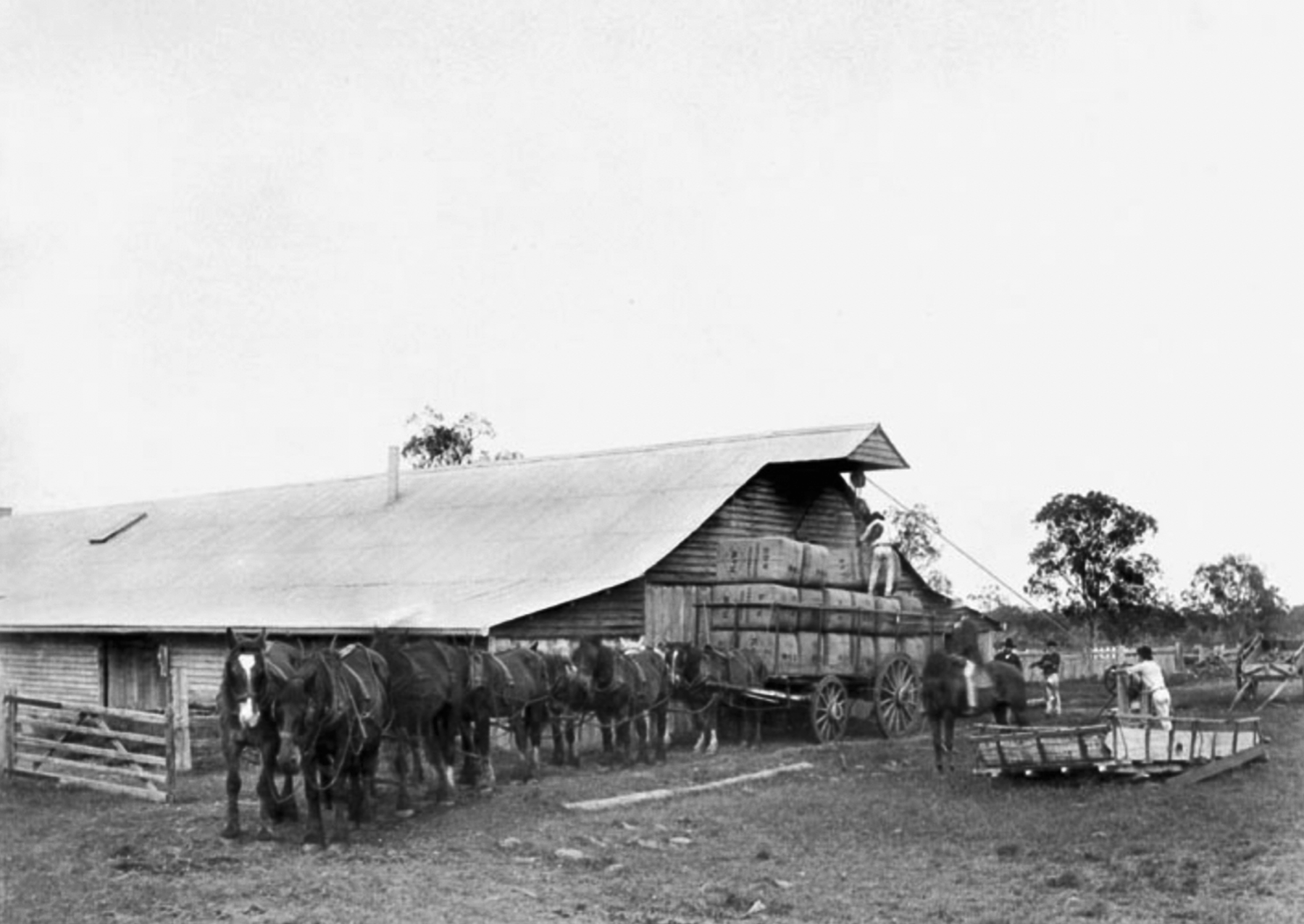
A wool-shed in Australia, c.1890 (Collection of the Author)
The world glimpsed here is only one part of the wider history uncovered inKin, Kilts & Kolonie. Across the book, G. Roger Knight follows Scottish families, including the McLachlans, through business, marriage, migration and return – from Java’s colonial society to Highland estates, Lowland towns, English suburbs, Dutch households and Australian descendants. For anyone tracing McLachlan history, or interested in the wider paths taken by Scots across empire, the full book offers a richly detailed account of how these family stories unfolded.
For anyone tracing McLachlan history, or interested in the wider paths taken by Scots across empire, the full book offers a richly detailed account of how these family stories unfolded. Kin, Kilts & Kolonie is available now in hardback and ebook from Amaurea Press.