
Maclaines in Batavia
Highland Kinship, Java Wealth & Colonial Life
In Kin, Kilts & Kolonie, G. Roger Knight follows the fortunes of Scottish families whose lives became bound up with the Dutch East Indies. At the centre of the story stands Maclaine Watson & Co., the Batavia merchant house founded by Gillian Maclaine of Mull. This extract follows the Maclaines into the European quarter of mid-nineteenth-century Batavia, where Highland kinship, colonial wealth and the domestic world of Java converged.
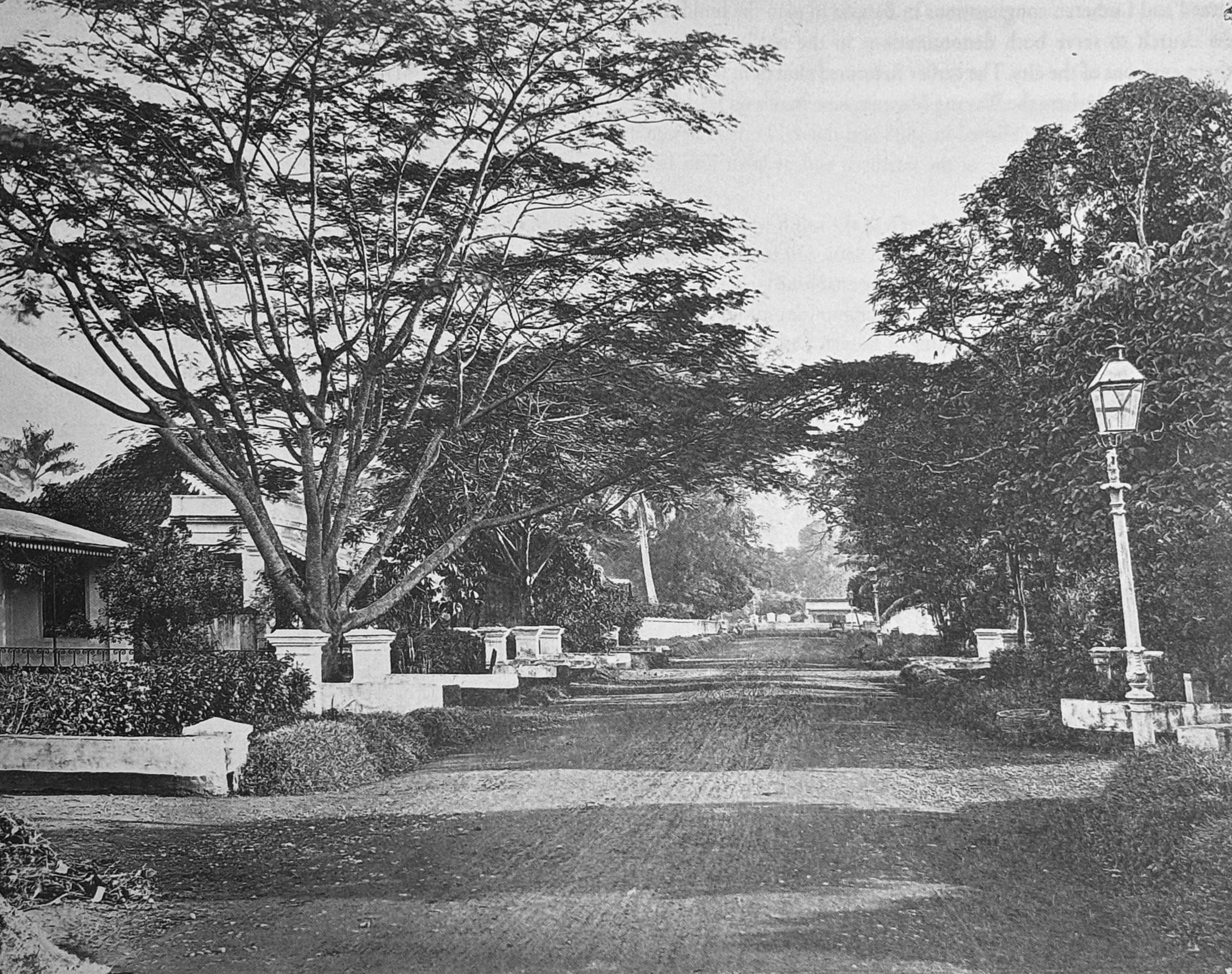
When Gillian and Catherine Maclaine returned from the highlands of Java in October 1832, they settled into the same house in Tanah Abang in which Maclaine himself had already been living for some years, at an address immediately to the west of the Koningsplein – the huge square which lay at the centre of the new European sector of Batavia, expansively laid out early in the nineteenth century, when the affluent among the colonists finally abandoned the mosquito-ridden old Dutch town that existed to its north.
![[f2.3p≈26] Batavia_s European Quarter 2 c.1850.png](https://images.squarespace-cdn.com/content/v1/683eb07ce2b5c10529fc0e5a/1779274235932-RY3N36L2HPYY0CM0R5SD/%5Bf2.3p%E2%89%8826%5D+Batavia_s+European+Quarter+2+c.1850.png)
![[f2.4p≈26] Batavia_s European Quarter 3 c. 1850.png](https://images.squarespace-cdn.com/content/v1/683eb07ce2b5c10529fc0e5a/1779274237162-HWNK3EB2LRM28DBXNKWL/%5Bf2.4p%E2%89%8826%5D+Batavia_s+European+Quarter+3+c.+1850.png)
![[f2.5p≈26] Batavia_s European Quarter 4 c. 1850.png](https://images.squarespace-cdn.com/content/v1/683eb07ce2b5c10529fc0e5a/1779274333327-PHSGVOKG0DGM46Z8O8TW/%5Bf2.5p%E2%89%8826%5D+Batavia_s+European+Quarter+4+c.+1850.png)
Batavia’s European Quarter, c.1850 (Collection Scott Merrillees, Melbourne)
As a woman who had hitherto spent most of her life within the tightly packed confines typical of a provincial town in the heart of the Netherlands, his wife would no doubt have found the experience as novel as were the mountains through which she had recently passed. The nearest we can come to an impression which this affluent part of the city made on new arrivals, however, is a report not from her but from her brother-in-law, Gillian Maclaine’s sole sibling, the Reverend Angus Maclaine, who visited the city in 1846.
By that date, his brother had been dead for six years: on his way back to Britain from Java in 1840, he, his wife, and their two young children were lost at sea, together with Catherine Maclaine’s mother and her two unmarried sisters, when their ship went down in a storm somewhere off Mauritius. His sibling (and sole heir) had arrived in the city on a steamer that had brought him from Singapore on a leg of a long journey that was taking him back to his sheep farm in Australia (where we shall meet him again in a subsequent chapter) from a lengthy stay in Scotland. What had brought him there was the need to finalise arrangements, complicated by the undocumented circumstance of his brother’s death, for the transfer of his inherited capital from the business partnership that continued to bear his late brother’s name.
Evidently the Reverend Maclaine was much taken with the spaciousness of the residence – quite possibly the very same that Gillian and Catherine Maclaine had occupied a decade earlier – which he shared with his temporary host, the Londoner John Lewis Bonhote. The son of the head clerk under whom Maclaine Watson’s co-founder had worked in London before he had shipped out to the Indies in 1820, Bonhote had joined the firm early in the 1830s, and by the time the Reverend Maclaine encountered him – and found him ‘exceptionally contentious and sometimes difficult to do business with’ – he was senior partner and evidently lived in an appropriate style. To be sure, grand colonial dwellings such as his were hardly unique to Java: after all, the top British officials and business people in the main cities of the Indian subcontinent likewise lived in a grand manner. Even so, for someone like the Reverend Maclaine, who had been to neither Calcutta, Bombay nor Madras, the wealthy European quarter of Batavia was literally something to write home about: the more so since his own rural farmhouse and urban cottage in South Australia, where he had been domiciled (in part) since the beginning of the decade, offered nothing remotely similar in scale or in the way of the everyday life lived there:
“[Its main] apartment [is] filled in the style of a drawing room, sixteen feet in height as is the whole house, and more than 60 feet by 30 feet in area. . . . The doors are open Venetian from about 4 feet from the floor, as are also the shutters of the windows – and these airy halls are lighted by handsome lamps suspended from the ceiling or equally handsome . . . lamps on stands. . . . In front is the veranda running along the whole breadth of the house, about 90 feet within walls and about half that in its breadth. . . . In the morning, which is always cool and pleasant, we meet [there] a little after 6 and have a cup of tea or coffee – and I often smoke a cigar – walk about the grounds, lounge or read as we feel inclined for an hour or two. Dress between 8 and 9 and breakfast at 10. After Breakfast . . . I employ myself reading, writing and sleeping until near five. Then I dress, ride, drive or walk until dark. Dine at 7 – at eight either make calls or return to the veranda . . . until 10, a friend sometimes dropping in to pass an hour. In the country they regularly sleep during the heat of day. This is the routine of Java life and this house may be taken as a good sample of respectable European residences.”
Among those ‘routines of Java life’ – for himself as a man of the cloth, but also for many of his contemporaries – would have been church attendance. On a steamer crossing the Mediterranean, on his way to the Indies, he had encountered ‘a native of Madras, an Indian black, going back as a Minister of our Scottish Church’, while ‘on Sunday the Captain read prayers to us all, assembled in the Cabin, and read them uncommonly well’. Transhipping in Singapore prior to boarding the Java-bound steamer, he had taken the opportunity of going to church:
“for we were in good time for the morning service. The church was handsome and commodious and the congregation most respectable, but I have heard better sermons. The Minister is, however, well-liked and respected.”
Whether Maclaine subsequently relished any sermons during his stay in Batavia is not evident from his surviving correspondence, but he may well have attended what was described at that time as the ‘British Church’ or (by his late brother) as the ‘English chapel’, a place of worship built in 1831 and at this stage in its history said to be multi-denominational.
The mid-nineteenth-century colonial order in the Indies, in which British arrivals like the Reverend Maclaine found themselves, has subsequently been designated (and romanticised) as a Tempo Doeloe – literally a ‘time past’ in the Dutch transcription of a Malay phrase, but better understood as ‘the Good Old Days’. Leisured and lordly, it came to be seen as the antithesis of subsequent, late colonial bourgeois ‘modernity’ and its concomitant self-consciously middle-class ‘European’ identity – and as such constituted a purportedly somewhat ‘orientalised’ social order that had drifted some distance from its Western moorings. Nonetheless, the Reverend Maclaine’s late brother, at least, may have viewed it rather differently: ‘I believe,’ he wrote to his Uncle Hector, ‘there are few places in the Indies more agreeable and more European than Java at present. Twice a week French Operas, Concerts and Balls every fortnight, races twice a year etc., etc.’, together forming a milieu in which his and his young wife’s participation was ‘sufficient to rub off tropical rust and keep up a sufficient quantum of polish for the “home market”’. The Reverend Maclaine himself, writing a decade later, was struck by something else, something apparent at an official reception that he attended immediately on his arrival in Batavia in July 1846: ‘the utter contempt for the climate’ shown by high-ranking officials, clad from ‘head to toe in black with stocks and straps, [aligned to] perfect European stiffness and correctness of costume’.
Moreover, for all its notionally Asiatic characteristics, Tempo Doeloe might well be better considered an Indies equivalent of the equally chimerical Antebellum American South, itself likewise a subsequently ‘lost world’. Some of the more resplendent photographic images of colonial life in mid-nineteenth-century Batavia and other of Java’s main urban centres do indeed support that characterisation. One mansion in particular, in the very centre of the European quarter – owned by the proprietor of an auction and import business, and leading member of the island’s British contingent, the Anglo-Welsh John Pryce – was a massive construction with a pillared front gallery, reminiscent of a stage-set for Gone with The Wind. Echoes of the Antebellum South were also present with respect to hospitality. A contemporary who was a frequent visitor to the Pryce household – where the chatelaine would have been Margaret Maxwell Maclaine-Pryce, a cousin of the Reverend Maclaine’s who had become widower John Pryce’s second wife in 1858 – was evidently awed by the scale and lavishness of the regular entertainments held there.
It is the image of the Pryce mansion itself, however, as reproduced from a contemporary photograph in one of the latter-day celebrations of Tempo Doeloe, that is most revealing: not least for the fact that before its grand façade, together with its proprietor and his Dutch business partner and brother-in-law, Willem van der Hucht, are stationed two dozen or so retainers and their children. Until the 1860s, they might well have been household slaves, the presence of whom in the Batavia mansions of the Dutch colonial elite – it was reported that one such house was entirely run by as many as fifty slaves – fitted awkwardly with the sensibilities of at least some European newcomers. In fact, before slavery was abolished in the Indies in 1863, there were nearly seven thousand slaves to be found in Batavia and on the landed estates of its hinterland, many of them, presumably, captives brought from the islands of what is today Eastern Indonesia.
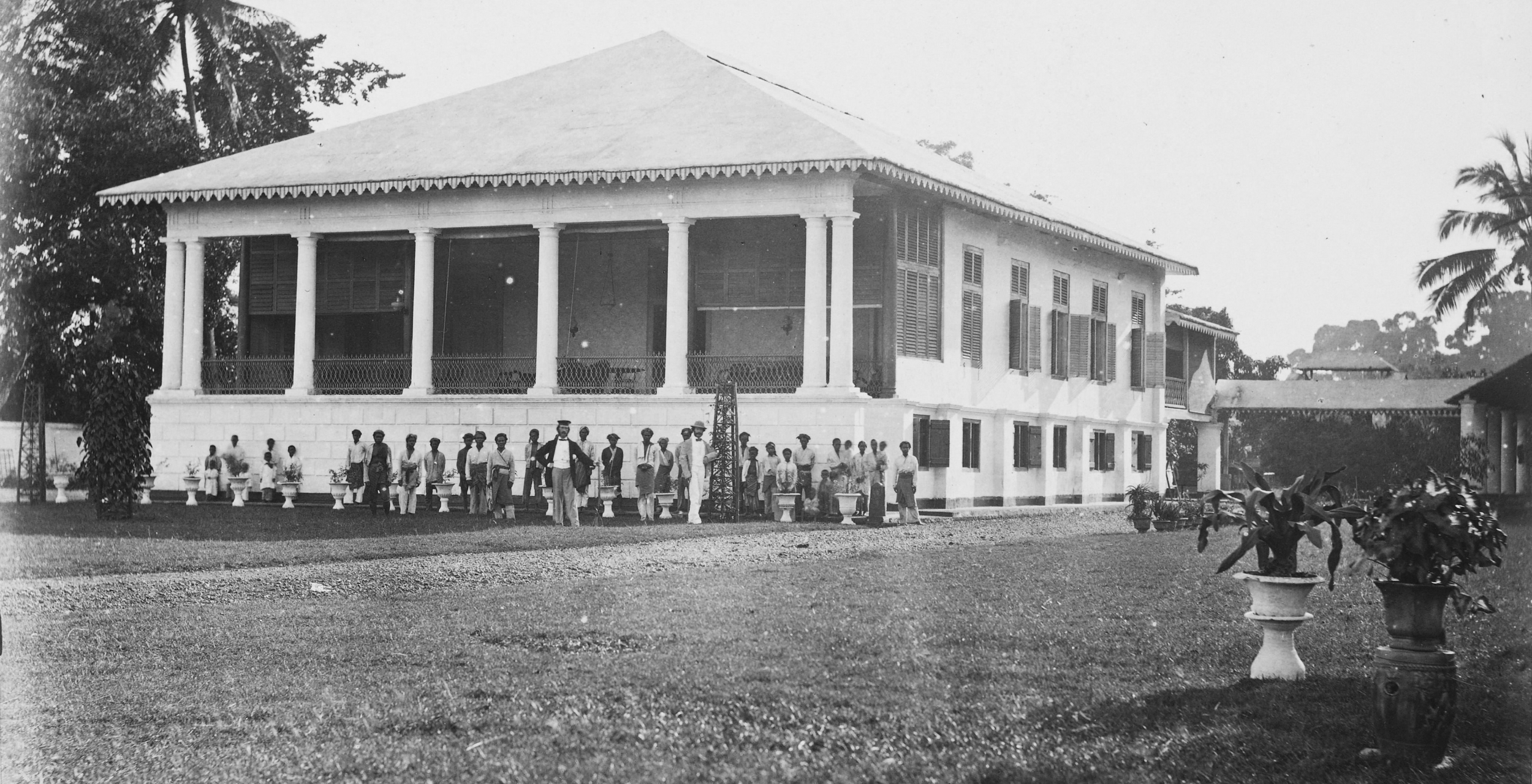
The Anglo-Welsh business man John Pryce’s house, Koningsplein, Batavia (KITLV/University of Leiden)
The world glimpsed here is only one part of the wider history uncovered in Kin, Kilts & Kolonie. Across the book, G. Roger Knight follows the Maclaines and their connected families through business, marriage, migration and return – from Java’s colonial society to Highland estates, Lowland towns, English suburbs, Dutch households and Australian descendants. For anyone tracing Maclaine history, or interested in the wider paths taken by Scots across empire, the full book offers a richly detailed account of how these family stories unfolded.
For anyone tracing Maclaine history, or interested in the wider paths taken by Scots across empire, the full book offers a richly detailed account of how these family stories unfolded. Kin, Kilts & Kolonie is available now in hardback and ebook from Amaurea Press.