
News from Beijing
By Ash Johann
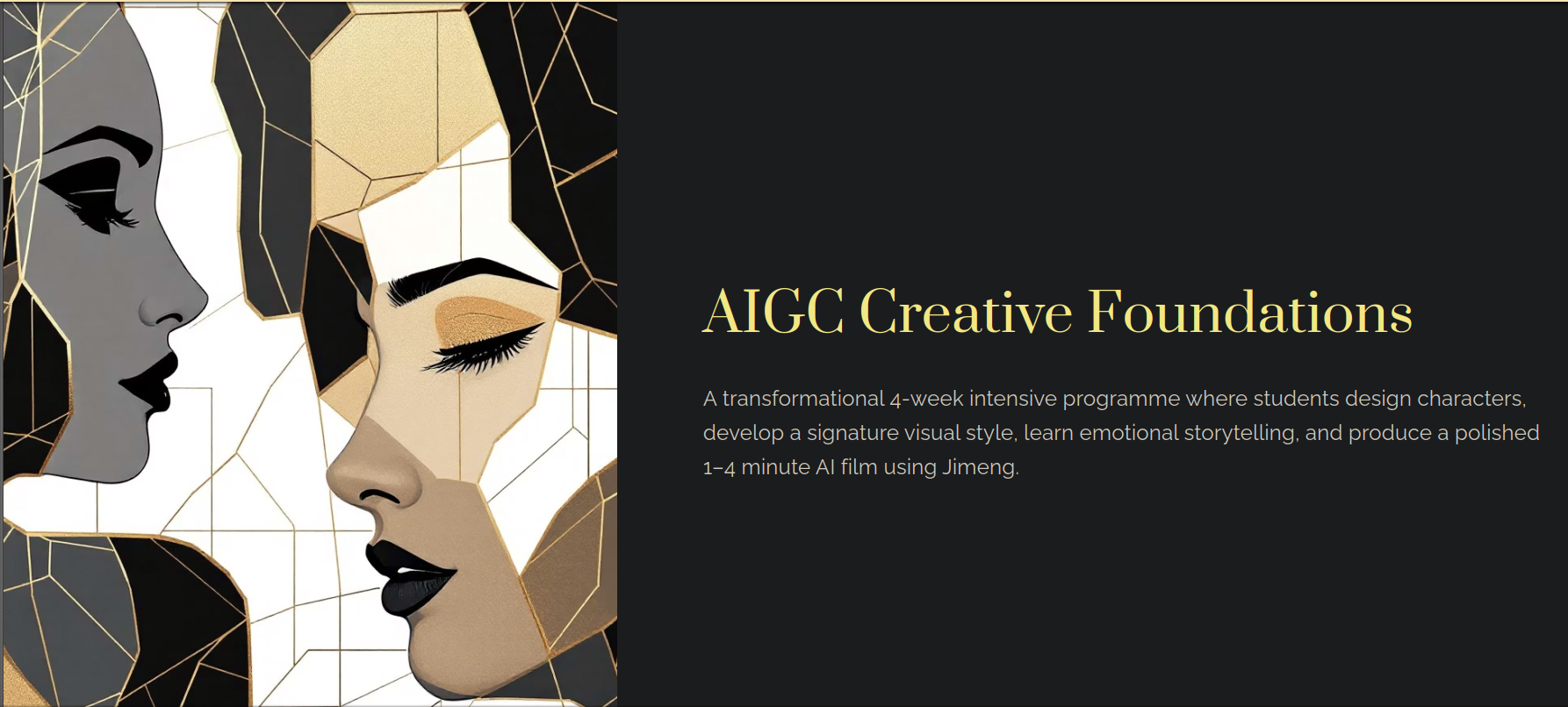
Over the last few weeks I’ve been deep in the planning stages of a new AIGC course, and it’s becoming far more interesting than I expected when I first sat down to sketch it out. I knew I wanted to do something creative rather than technical, something that helps people actually ‘make’ something meaningful rather than simply learn the mechanics of a tool. But once I began designing the structure, it started to take on a life of its own.
What has emerged is a month-long journey that mirrors the natural progression of filmmaking: beginning with characters, expanding into worlds, and then unfolding into story. It turns out that starting with character, especially characters modelled on the students themselves, gives the whole process a kind of emotional anchor. People immediately have something personal to work with, something that feels alive. From there it becomes much easier to imagine the visual worlds those characters might inhabit, and suddenly the images aren’t just outputs from an AI model, but actual locations that hold narrative potential.
I’ve been particularly fascinated by how expressive these AI characters can become. With the lip-sync and performance features now available, students will be able to make their characters talk, emote, shift expression, and even act out little moments. It feels like handing people a tiny animation studio, one that responds to their imagination in real time. The more I plan the flow of the lessons, the more I realise the course is not really about ‘AI skills’ at all, but about giving people a safe structure in which to rediscover storytelling.
I’m still shaping the world-building component, which sits at the heart of the second week. Here the style, mood and atmosphere of the film start to take form; but crucially, only after the character exists. Without that foundation, the imagery risks feeling decorative or directionless; with it, the visuals gain purpose and gravity. And then, in the third week, everything turns toward emotion and narrative flow: how scenes connect, how a feeling evolves shot by shot, and how to create a sense of movement across time.
By the end of the month, the aim is for each participant to produce a short 1 to 4 minute film. But for now, all of this is still on paper: outlines, diagrams, fragments of lesson plans, little tests of what might work. I’m enjoying this stage more than I expected. There’s something very alive about designing a system that will (hopefully) open new creative pathways for people. It feels less like assembling a curriculum and more like mapping out a tiny ecosystem where imagination can stretch a bit further than usual.
I’ll share more as the shape becomes clearer, but for now, that’s what I’ve been absorbed in: trying to build a course that feels genuinely creative, humane and artistically freeing, even for people who’ve never thought of themselves as storytellers.
While I’m building this new AIGC creative incubator, I also want to share an opportunity for anyone already making work, exploring film, or experimenting with AI and narrative. Submissions are now open for the St Andrews Film Festival (https://www.saintfilm.org.uk), a space for independent and experimental films of all kinds. If you’re creating short films, cinematic experiments, AI-driven visuals, or personal stories that deserve an audience, I’d love to encourage you to submit your work. SAFF has become a place where fresh voices and inventive approaches can be seen, discussed and celebrated by a wider community, and I’m excited to connect what we’re building in the course with this larger festival platform.