
Across China with Haoabout

One of the most exciting developments for Amaurea in Beijing over the past year has been our growing partnership with Haoabout, a cultural media platform telling stories about Chinese places, traditions and everyday life for audiences beyond China.
For Amaurea, the relationship has grown organically through the work of our Beijing-based co-director, Ash, who has been collaborating with the Haoabout team both in front of and behind the camera. What began with participation in individual films has increasingly involved editing, cinematography and the shaping of longer-form stories — and is now developing towards a documentary project that Amaurea and Haoabout will collaborate on.
Much of Haoabout’s work begins simply by going somewhere, meeting people and seeing what happens: not presenting culture at a distance, but entering into everyday life, eating, talking, travelling and listening.That spirit carried us to Yanji, in Jilin province, where Jon and Eldy joined Ash at the heart of one of China’s largest Korean communities, close to the North Korean border. The journey moved through rice-cake pounding, lantern-making, archery, wrestling, markets, dancing and Korean food, before opening onto quieter fragments of history: a house filled with photographs from the 1930s, memories of people crossing the river to trade, an unexpected Christian church, and finally the Tumen itself, with North Korea just across the water.
That spirit carried us to Yanji, in Jilin province, where Jon and Eldy joined Ash at the heart of one of China’s largest Korean communities, close to the North Korean border. The journey moved through rice-cake pounding, lantern-making, archery, wrestling, markets, dancing and Korean food, before opening onto quieter fragments of history: a house filled with photographs from the 1930s, memories of people crossing the river to trade, an unexpected Christian church, and finally the Tumen itself, with North Korea just across the water.

Korean Food in China: Our First Day in Yanji catches the exuberance of that first day;
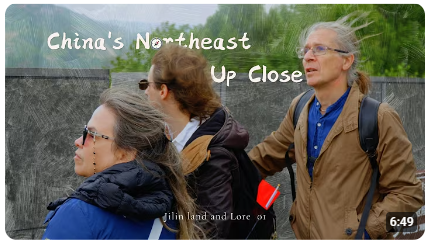
the longer Taking my Parents to the North Korean Border – Jilin, China, becomes something more reflective: a film in which the great currents of history remain at the edges, while ordinary lives continue in their midst.
Before Jilin, the collaboration had already taken Ash west to Bayannur in Inner Mongolia. The videos coming from this project catch the spirit of arriving with curiosity, following the people you meet, eating what is put before you, and letting the landscape disclose itself along the way. From Linhe, the journey ran north across the Yinshan Mountains and into the Urad grasslands, through an old mountain pass, desert roads and finally a contemporary wedding still carrying traces of older Mongolian traditions.
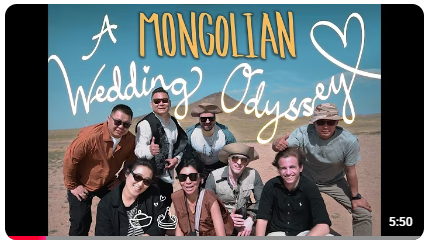
Over the Mountains, Across the Desert, for a Urad Wedding, follows that passage in fuller form,

while Across the Sand Sea, Witnessing a Love that Knows no Narrowness distils it into something more impressionistic: an early-morning drive, Mongolian rock, desert, history and the sheer openness of the land converging around the wedding itself.
Other Haoabout films explore cultural practices on a much more intimate scale.
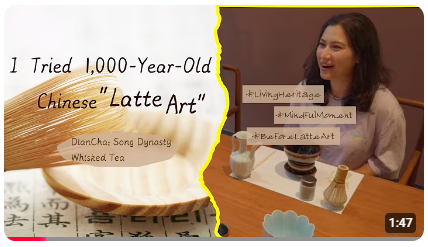
For example, I tried 1000-year old Chinese ‘Latte Art’ introduces diancha, the Song-dynasty practice of whisking powdered tea into a dense foam and creating fleeting images upon its surface. What looks initially like a curious historical technique becomes something more contemplative: an artwork whose disappearance begins almost as soon as it has been made.
These films are also part of a broader development within Amaurea. From our beginnings in publishing, Amaurea has gradually become what we originally hoped it might be: a creative studio working across forms and between places. With Jon based in London and Ash in Beijing, film offers another way for us to explore the histories, cultures and human encounters that have always interested us — but through movement, image, sound and collaboration.
The next stage of our work with Haoabout takes us into a longer family story. Art and Memory of a Chinese Family: The Ma–Zhu Cultural Archive is an exploratory documentary project whose story begins with Zhu Rongzhuang, the most celebrated artist in the family: a late-Qing and Republican-period painter associated with Shanghai’s Haipai tradition. From his world of Jiangnan and Shanghai, an artistic inheritance passes through later generations — including the artists Zhu Mingqing and Zhu Mingxin — and through the upheavals and migrations of twentieth-century China, eventually reaching Ma Yue and her late brother Ma Liang. Ma Liang became a poet, critic and cultural figure in Hainan, gathering his life’s writings into seven volumes shortly before his death.
Working together, Amaurea and Haoabout hope to follow those connections through artworks, writings, family memories and the places in which they were made — from the Jiangnan and Shanghai art worlds, through the family’s experience in Jiangxi, to Hainan’s island landscape and literary culture. The aim is not simply to recover the history of a remarkable creative family, but to explore what happens to art and memory as they are carried across generations and through the transformations of modern China.
Haoabout will bring its experience of filming across China, working with places and people on the ground and finding visual ways into their stories. Amaurea will bring Ash’s filmmaking and developing research practice together with our own interest in archives, history, storytelling and the relationships between different media.